
Harlem Arrests Across Agencies
Harlem sits second among Columbia County's two incorporated cities. It was home to 3,571 people at the 2020 Census. Its police department delivers full municipal service and keeps the material its own officers create. County systems still loom large, though. Dispatch is contracted to the Columbia County Sheriff's Office. Anyone moved into county custody can end up at the detention center in Appling.
That split leaves a three-part trail behind a single arrest. The city report captures the incident. It names the arresting officer, the location, and a local case number. County detention tracks intake, bond, release, and any booking photograph. The court file arrives later. It records the final action a judge took. No one of these records can stand in for the other two.
Where Harlem Arrests Are Published
Harlem publishes no daily arrest log. It posts no public booking blotter either. The city police page is a contact resource, not a live roster. CCSO's Inmate Inquiry page likewise reports that its online current-custody list has been withdrawn. Treat older county feed routes as legacy options at best. None carries a working date window, update schedule, archive depth, or current photo display.
| Source | Record or status | How to use it |
|---|---|---|
| Harlem Police | Police incident and arrest report | Official city request |
| CCSO dispatch | Non-emergency routing | Official county line, 706-541-2800 |
| Detention Center | Booking and present custody | Official inquiry, 706-541-0754 |
| Georgia VINE | Custody and change alerts | Official participating service |
| Regional reporting | Selected incidents and later stories | Unofficial; verify each claim |
The official county-government explanation lists Harlem as one of Columbia County's two incorporated cities.
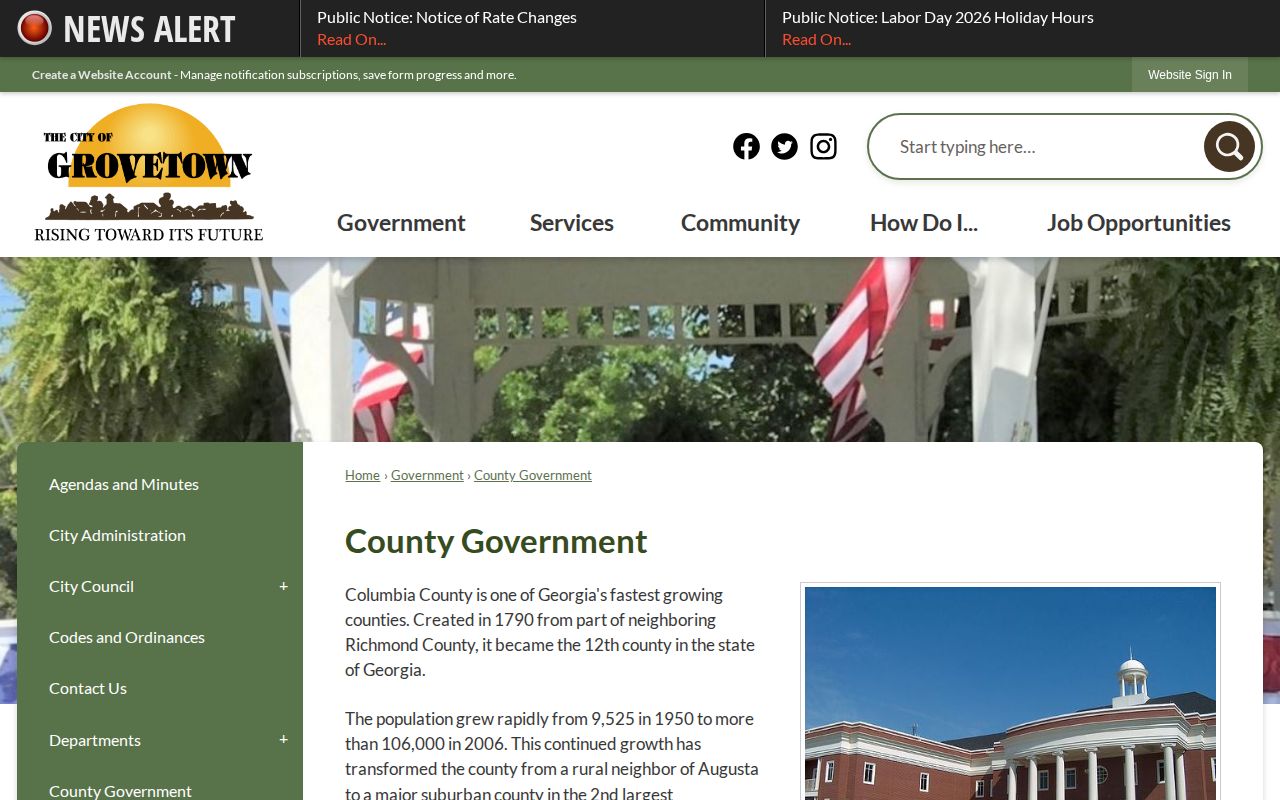
The page frames how Harlem's municipal records sit inside the wider county arrest system.
Check a Harlem Arrest
Start with custody status. Someone just arrested may still be in transport or intake. A person currently held can be confirmed by detention staff or VINE. Release changes things. A released person may drop off a current custody check. The city report and booking file still exist. Anyone moved to state prison belongs in the Georgia Department of Corrections search instead of a county jail inquiry.
- Call the detention inquiry line and ask whether county intake is complete.
- Use Georgia VINE for a specific person's custody status and available notifications.
- Contact Harlem Police for the incident or arrest report.
- Send CCSO a separate request for the booking sheet and any releasable intake photo.
- Check the Columbia County Clerk or Odyssey portal for later court activity.
A blank online result does not rule out an arrest. Transport, medical clearance, identity checks, and data entry can each delay the record. Double-check spelling, and add a date of birth or case number when you can, so similar names don't collide.
Harlem Police Arrest Records
For city-held material, the Harlem open-records page is where to begin. Email works too, through pdrecords@harlemga.org, the department's most specific records channel. Name the subject, give the incident date or range, add the location if known, and state the exact document you want. Routine police records may stay with the department. Broader requests can move through city administration.
Don't mix up the two addresses. The public-safety building stands at 110 West Milledgeville Road, Harlem, GA 30814. City mail goes to P.O. Box 99, Harlem, GA 30814. Ask which one applies before mailing anything.
110 West Milledgeville Road
Harlem, GA 30814
Office: 706-556-6262
County dispatch: 706-541-2800
Records: pdrecords@harlemga.org
A city report may not include the county booking photograph. If the detention center made the image, send that request to CCSO with the person's name and booking date. Georgia law can restrict release or require a compliant-use statement, and a custodian may redact or withhold material under a cited exemption.
Dispatch Shapes Harlem Arrest Records
One Harlem arrest can pass through several offices because of the dispatch contract. CCSO dispatch routes the call, and a Harlem officer writes the municipal report. Detention staff build the booking record. Each record answers a different question. Dispatch data covers the call and response. The police report covers the alleged event and the arrest. Detention data covers intake and custody.
When an office doesn't hold a record, ask the custodian who does. That saves you from repeated broad requests and helps reconcile mismatched times. Arrest time, arrival time, and completed booking time are three distinct moments. A court filing date is different again.
Harlem Arrest News and Photos
The Jail Report runs weekly. It has covered Harlem incidents and selected Columbia County booking photos on that cycle. The Georgia Gazette indexes county crime and court items. Other regional newsrooms publish story-based reports. These outlets can pin down a date or an agency. They are not custody lists. Arrests get omitted, coverage lags the event, old facts get repeated, and charge language can shift once a case reaches court.
Use a publication only as a lead. Match its date and agency against Harlem Police records, check booking claims with CCSO, and confirm final case status with the court. A city label in a third-party entry doesn't prove which agency made the arrest. Photos on those pages should stay there rather than being copied anywhere.
Booking Photos After Harlem Arrests
A booking photo can exist even when no website displays it. The CCSO notice posts no live inmate grid and no current photo policy, so the image lives with the office that made it. Ask that agency directly. Give the subject's name, the booking date, and the arresting office tied to the Harlem arrest. Request a written reason if any part of the record request is denied.
Any photo you receive is only one piece of the file. Pair it with the booking sheet and the court docket. A photograph captures one moment. The paperwork carries the full story of the case.
Reading a Harlem Arrest Entry
Field labels tell you who created each fact on a Harlem arrest entry. The arrest date and time reflect the officer's action. Booking time marks completed intake at county detention. Harlem Police can appear as the arresting agency while CCSO handles the booking itself, and a case number may belong to either the police department or the court, so always cite the label when ordering another record.
Wording deserves close attention too. A short jail label records what was booked at intake, and bond terms can shift after a hearing, so treat both as provisional rather than final. A release date only confirms that county custody ended; the court docket holds the outcome.
Identify people carefully when you search. Full name and suffix will separate similar names. Date of birth when listed and a case or booking number help too. Address labels and physical descriptors can carry errors or sensitive details, so never rely on them alone as an identity match.
After a Harlem Arrest
A few terms unlock the whole timeline. Booking is jail intake. It covers identity review, charge entry, a property inventory, the photograph, and bond data. Arraignment is the early court stage where charges are addressed. Bond is the release condition set by law or a court. Disposition is the final result, whether dismissal, plea, acquittal, or sentence.
Together the agencies form one chain. Harlem Police records open the timeline. CCSO documents county custody. The Clerk or Odyssey court system finishes it. Keep the agency response and case number whenever you request a correction. Later court entries can correct what appeared at booking. An old news page never will. That paper trail shows which fact came from police, jail staff, or the court.